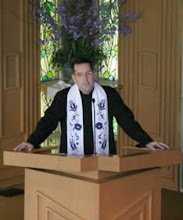
Easter 2011, High Plains Church, Colorado Springs
Rev. Roger Butts
So on Tuesday High Plains had a passover seder--led by the Solters and Alan Gershanov and Nathan Mesnikoff. During that time, we said aloud names of freedom-lovers, lovers of justice and peace. On Friday, we had a Good Friday service and we sang and we told the story of Jesus and we left it at the moment of his crucifixion. So today, let's read how it all plays out.
The passage
When the Sabbath was over, Mary Magdalene, Mary the mother of James, and Salome bought spices so that they might go to anoint Jesus' body. Very early on the first day of the week, just after sunrise, they were on their way to the tomb and they asked each other, "Who will roll the stone away from the entrance of the tomb?" But when they looked up, they saw that the stone, which was very large, had been rolled away. As they entered the tomb, they saw a young man dressed in a white robe sitting on the right side, and they were alarmed. "Don't be alarmed," he said. "You are looking for Jesus the Nazarene, who was crucified. He has risen! He is not here. See the place where they laid him. But go, tell his disciples and Peter, 'He is going ahead of you into Galilee. There you will see him, just as he told you.' "
Trembling and bewildered, the women went out and fled from the tomb. They said nothing to anyone, because they were afraid.
---
That is the story.
And so much time and so much effort has been placed on whether it is a historical narrative or not,
whether it is a culmination of the God of Israel’s desire and understanding even before the world began. That Jesus’s death was preordained and predetermined and crucial to the salvation of humanity.
And for those on the left,
the "factuality" of it all have led certain christian scholars to say of the burial of Jesus things like this:
the burial of jesus by his friends is of course a falsehood.
He would have been buried by his enemies in the roman bureaucracy
and the grave would have been shallow enough
to have wolves and dogs get to Jesus body without any trouble.
This morning I don’t want to focus on either of those approaches.
Rather, I want to invite you to take a look at this story as a parable.
Is this a story we normally think of as a parable?
No, we normally think of something like the good samaritan.
A parable is something in which one thing is laid out alongside another thing
and both are understood in new ways.
You think the kingdom of god (the beloved community)
is full of people who are pure and perfect and insiders,
but Jesus comes along and tells a story,
a parable about the kingdom of god in which a king is having a dinner party
and all the beautiful people have other things to do, other obligations,
and the king says, just go and pick some people off the streets and we’ll have a feast to end all feasts.
The kingdom of god is like this jesus says and suddenly everything looks different.
This morning I want you to think of your own stories of ‘resurrection’
and lay them down beside the story of jesus’ resurrection
and see if you have a parable on your hand.
Let me try to ‘explain’ a parable like this.
Have you ever known someone,
say at work or someone you met at a dog park
and you think you know this person pretty well, what they like, what they dislike, what their habits are.
And you go along like that for a long time,
and then one day you meet their spouse.
And you’re like Whoa,
I’ve got a new perspective on old Henry, on good old Henrietta.
Now, That’s a parable!
Or consider this story.
In Davenport, where I served seven years,
there was a woman who had been in the church since the mid-1970s.
She was a teacher, a retired teacher.
She was an associate at one of the catholic monasteries in town and a committed UU.
Every Sunday she was at church.
Every Wednesday night, she was at the dinner and worship and adult education offerings we offered.
She inspired a whole generation of newcomers in that congregation by her simple presence,
her sharing of poetry and wisdom,
her compassion and concern for others.
Let’s call her Anna.
And one day, she fell in love,
after being single for many many years.
And everyone of course was thrilled for her.
Her happiness belonged to the whole church.
It turns out, however, that her beloved was a traveller,
a man who spent nearly all of his time in places like Australia
and New Zealand and Prague and Paris and Costa Rica.
He was born a rambling man.
And she, in all of her gentleness and bravery and goodness,
had a profound fear of traveling.
She was a home body and a life in planes and trains and automobiles
was not her idea of security or wholeness.
And one day she said, toward the end of the year,
I’m traveling to Australia for a month.
And as the time came closer,
her agitation increased and increased. She fell into a deep funk.
The Anna we knew seemed distant and a bit lost to us.
One day a group of women were to go out to a retreat center for a weekend women’s retreat.
It was around early November.
I received a call early in the morning,
around 9 a.m.
Anna is not here, one of the women said to me.
And she never misses something like this.
We are worried.
I agreed to go and meet the two women at Anna’s house.
Anna’s car was in her garage.
Her house was dark. We were sorely afraid because none of this added up.
Was Anna ok?
We did some checking with some of her friends to no avail.
We decided, just to be super safe, to call the police.
We got in to her house and she had swallowed a great number of pills.
She survived this attempt to end her life,
but she was assigned to a mental unit at the local hospital.
She was seriously lost to us.
After some weeks, I called together some of the leaders of the church,
some of her catholic friends and some of her community friends
and we talked about the best way to support Anna.
In my heart of hearts I started to sense that Anna would not come out of this funk,
would not survive the next attempt, would not come out of her mental illness.
I shared with a few people that they might think about life without Anna,
that she might be lost forever to us.
Joe sings: Love Will Show the Way by David Wilcox
http://www.youtube.com/watch?v=cy0LBGTYyfg
Well, since this is an Easter parable and since the young man is sitting there at the edge of the tomb saying: Why are you looking for the living among the dead?,
you probably will realize that Anna recovered
and found her way back to life and wholeness
and her continued ministry of compassion and connection.
Even now, Anna sends Norah cards and pictures of red birds
based on a sermon I gave nearly ten years ago
and the kids say: Anna sent it, right?
Even now, as Davenport has called a new minister
and newcomers come into that place long after I have gone,
Anna greets a newcomer and says:
I’m glad you are here--oh, you’re a such and such,
I think you might enjoy meeting so and so.
In my mind’s eye I saw Anna in her casket.
I saw her as having given up on life.
I prepared myself for the despair and confusion and sadness of imaginging life without Anna
and the congregation without Anna--not out of malice just out of a sense of “realism.”
I was the guy with the white robe on
but I was doing the exact opposite,
lovingly trying to make it better by preparing for the worst.
Not so fast, she said.
Why are you looking for the dead among the living?
The living spark inside my soul, inside my spirit LIVES still.
the poet Antonio Machado says it well:
I love Jesus, who said to us:
heaven and earth will pass away.
When heaven and earth have passed away,
my word will still remain.
What was your word, Jesus?
Love? Forgiveness? Affection?
All your words were
one word: Wakeup.
You heard the song that Joe sang this morning:
it is love that mix the mortar
and love that stacks these stones
and its love that made the stage her,
though it looks like we’re alone.
in this scene full of shadows,
like the night is here to stay, there is evil cast around us
(there is despair, there is confusion, there are missed chances, missed opportunities, regrets, sadness)
but it is love that wrote the play
and in the darkness love will show the way.
Towards the end of my time in Davenport, I used to say at Easter:
so many of you are my Easter stories--
I was especially thinking of Anna.
And today, here in colorado springs,
we know that each of our lives is a kind of gospel story.
Some of us may believe that it is not possible for us to get out of that tomb that we’re trapped in.
Some of us may believe that there are just no more words of hope, no more chance of waking up.
But the gospel of your story in every moment has a chance to walk towards the peace of life,
the transforming power of love.
It is not too late, as it was not too late for Anna.
As it was not too late for Jesus, at least in the actions and commitment
of those who found in him a word of eternal life and hope.
They said to themselves: we will keep this man alive
by embodying what is most precious and life-saving about his life and teachings.
Anna said: I will keep going even though my despair was huge
because I have seen the power of my faith
the power of my connectedness with my deepest values and aspirations
and the power of the connectedness of my communities in which I find meaning and purpose,
including at the Unitarian Church.
I saw the new life that came to the congregation,
the new energy, the relief and the faith
as a result of Anna’s grace and power and commitment--
to life, to waking up.
I was a witness to resurrection.
And I imagine that it is the same grace and power that came to the disciples who said:
we will keep this thing going.
They too were witness to resurrection!
Alongside the story of Jesus,
I lay aside a story that for me is more immediate and real,
the story of Anna and her commitment to wake up and to life
and I understand both stories better.
Your life, too, is full of such gospel messages.
What stories can you lay alongside this story
and gain deeper appreciation and understanding
for your story and the Jesus story, the Anna story?
What saving message is waiting to be birthed,
is waiting to emerge, in the gospel of your life?
Happy Easter and God Bless the Whole World.